Geological Souls: How Deep Time Transforms Fictional Universes Into Living, Breathing Worlds
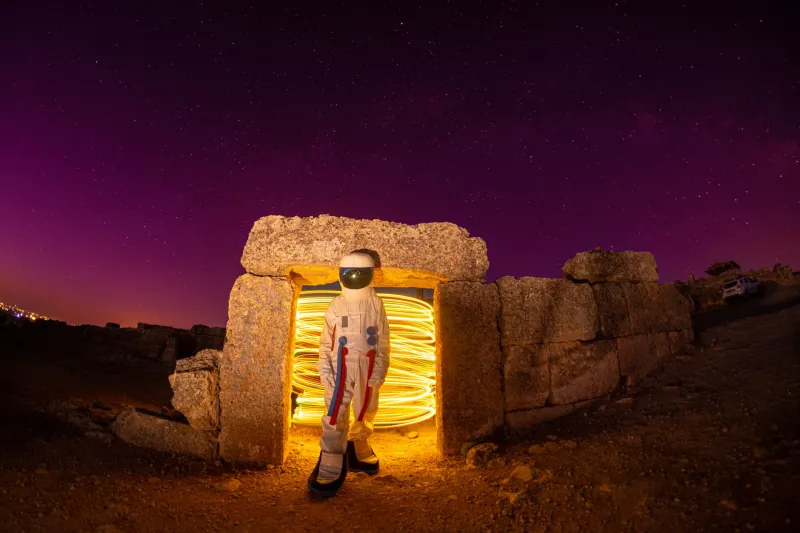
There's a specific feeling you get when a fictional universe hits different. Not just "cool setting" different, but genuinely ancient different — like the world existed for thousands of years before the story bothered to notice you were there. You feel it flipping through the appendices of The Lord of the Rings. You feel it when a Fremen elder in Dune casually references a prophecy seeded by the Bene Gesserit centuries before Paul Atreides was even born. You feel it in the crumbling Precursor ruins of a dozen beloved sci-fi video games.
That feeling has a name, borrowed straight from geology and evolutionary biology: deep time.
And the worldbuilders who understand it — really understand it — are the ones who build universes that stick with you for life.
What Deep Time Actually Means (And Why It Matters for Fiction)
In science, deep time refers to the almost incomprehensible scale of Earth's geological and biological history. We're talking billions of years — timescales so vast that human civilization is basically a rounding error. The concept was popularized by geologist John McPhee in the 1980s, but the underlying idea goes back to 18th-century Scottish geologist James Hutton, who looked at rock strata and understood, maybe for the first time in Western thinking, that the planet had been quietly doing its thing for an almost unimaginable stretch before humans showed up.
 Photo: James Hutton, via desilusion.com
 Photo: John McPhee, via d3owcl6pd5zkqc.cloudfront.net
When great sci-fi and fantasy authors apply this same lens to their fictional universes, something remarkable happens. The world stops feeling like a backdrop and starts feeling like a character. History isn't just a list of events in a timeline appendix — it becomes sediment. Each layer of civilization, conflict, and myth presses down on the one beneath it, shaping everything your reader experiences at the surface.
Tolkien was arguably the master of this. Middle-earth didn't begin with Bilbo Baggins finding a ring. It began with the Music of the Ainur — a creation myth that predates the world itself. By the time we reach the Shire, we're already standing on top of thousands of years of war, loss, and transformation. The hobbits don't know most of it, and honestly, neither do most readers. But you feel it. That weight is real.
The Dune Method: History as Sedimentary Pressure
Frank Herbert's approach in Dune is a masterclass in using deep time as narrative pressure rather than mere background decoration. The Butlerian Jihad — the universe-altering war against thinking machines — happened roughly ten thousand years before the events of the novel. Herbert never dramatizes it directly. He doesn't need to. Its consequences are baked into literally every institution, religion, and human habit in the story. The prohibition on computers. The existence of Mentats. The entire social order of the Imperium.
This is the key insight: deep time doesn't have to be shown to be felt. The past reshapes the present through consequences, not flashbacks. When you read about the Spacing Guild's monopoly on interstellar travel, you're feeling the gravitational pull of ten millennia of history without Herbert having to stop and explain all of it.
Game designers in the sci-fi and fantasy space have picked up on this hard. The Halo franchise's Forerunner lore, the ancient history of the Leviathans in Mass Effect, the pre-Collapse era in Destiny — these are all examples of worldbuilders using deep time to create what fans often call "lore depth." The universe feels like an iceberg. What you see in the story is just the tip.
Practical Techniques for Injecting Deep Time Into Your Own Worldbuilding
Okay, so how do you actually do this in your own creative projects? Whether you're writing a novel, running a tabletop RPG campaign, or building out a setting for a fan fiction series, these techniques translate surprisingly well.
1. Build your history in geological layers, not linear timelines. Instead of writing a chronological list of events, think in eras. What were the dominant forces of each era — ecological, political, spiritual? How did each era leave physical and cultural residue on the next? A ruined aqueduct in your fantasy city isn't just flavor text; it's a layer of sediment from a previous civilization your current characters barely understand.
2. Let your characters be ignorant of their own history. Real people don't know everything about the past, even their own culture's past. Your characters shouldn't either. Gaps, myths, distortions, and outright fabrications in historical memory make a world feel lived-in. If your protagonist confidently explains exactly why the ancient empire fell, that's a history lecture. If they're working from a half-remembered legend their grandmother told them, that's deep time.
3. Use language and naming as fossil records. In the real world, place names often preserve languages that are otherwise extinct. "Mississippi" is an Ojibwe word. Much of the American Southwest has Spanish place names layered over Indigenous ones. In your world, old words embedded in modern speech can signal the presence of forgotten civilizations without a single line of exposition.
4. Make your ruins do narrative work. Don't just describe ancient structures as "impressive" or "mysterious." Think about what they tell us about the people who built them — and what the current inhabitants' relationship to those ruins reveals about cultural memory, reverence, or erasure. A society that builds its marketplace inside a crumbling cathedral is telling you something important.
5. Give your world a geological event horizon. Every deep-time universe benefits from having at least one point in the past so remote that even the scholars in your world can't see past it clearly. Tolkien had the Music of the Ainur. Herbert had the Butlerian Jihad. The Elder Scrolls has the Merethic Era. This horizon creates a sense of genuine unknowability — and nothing signals "ancient world" quite like the presence of things that cannot be fully explained.
The Slotharian Angle: Slow Is the Point
Here at The Slotharian Chronicles, we've always had a soft spot for the unhurried approach — the stories and worlds that refuse to rush, that ask you to sit with them awhile. Deep time worldbuilding is the ultimate expression of that philosophy. It says: this universe didn't arrive fully formed for your convenience. It accumulated. It weathered. It carries scars and sediment from ages your characters will never fully reckon with.
That's not a limitation. That's the whole magic.
The fictional universes that stay with us longest aren't the ones with the flashiest magic systems or the most elaborate starship designs. They're the ones that feel like they were already old when we arrived — and will keep going long after the story ends. That's the gift of deep time. And it's available to any worldbuilder willing to think slow, think big, and let history press down like stone.