Where Nothing Lives: The Empty Spaces That Haunt Fiction's Greatest Worlds
The map is always more interesting at the edges. Where the careful labels and illustrated landmarks give way to blankness — that's where the real worldbuilding lives. Or rather, where it conspicuously doesn't live. And that's exactly the point.
Emptiness in genre fiction is one of the most underappreciated tools in the worldbuilder's kit. Not because writers ignore it, but because readers often do — treating deserts, voids, and ruined cities as scenery rather than story. But spend enough time with the great fictional universes and a pattern emerges: the spaces that contain nothing are often saying the most.
What Desolation Actually Communicates
There's a difference between empty space as backdrop and empty space as argument. The former is set dressing — a wide shot establishing distance and danger before the plot moves on. The latter is something a world is actively telling you about itself.
When a fictional universe builds a vast, uninhabitable wasteland between two civilizations, it's not just creating a travel obstacle. It's encoding history. Something happened here. Something that made this place unlivable, or drove away whoever once called it home, or perhaps never permitted life to take root in the first place. The absence is a record.
The best genre fiction uses this deliberately. Readers encounter the emptiness and feel the weight of what isn't there — the civilization that burned, the people who fled, the ecosystem that collapsed. It's grief rendered in geography. And it hits differently than any expository paragraph explaining the same history could.
The Desert as Pressure Cooker
Deserts are arguably the most narratively productive of fiction's empty spaces, and it's not hard to see why. Strip away comfort, community, and routine, and you get character — raw, unfiltered, and impossible to fake.
There's something deeply American about this particular use of landscape. The frontier tradition — the idea that vast, harsh, empty terrain reveals what people are made of — runs through US culture from Westerns to road trip novels. Genre fiction inherits this and amplifies it. The desert crossing isn't just a plot beat; it's an interrogation. What does your character want badly enough to cross this? What do they carry? What do they abandon?
Worldbuilders who understand this use desert spaces not as obstacles but as crucibles. Characters enter one way and exit another — changed not by a dramatic confrontation but by the slow, grinding pressure of emptiness itself. No villain required. The landscape does the work.
This is also where isolation becomes its own kind of character. In a desert — literal or metaphorical — there's no society to perform for, no role to play, no comfortable routine to hide behind. The emptiness forces honesty. And honest characters are where the best stories live.
Abandoned Cities and the Weight of What's Missing
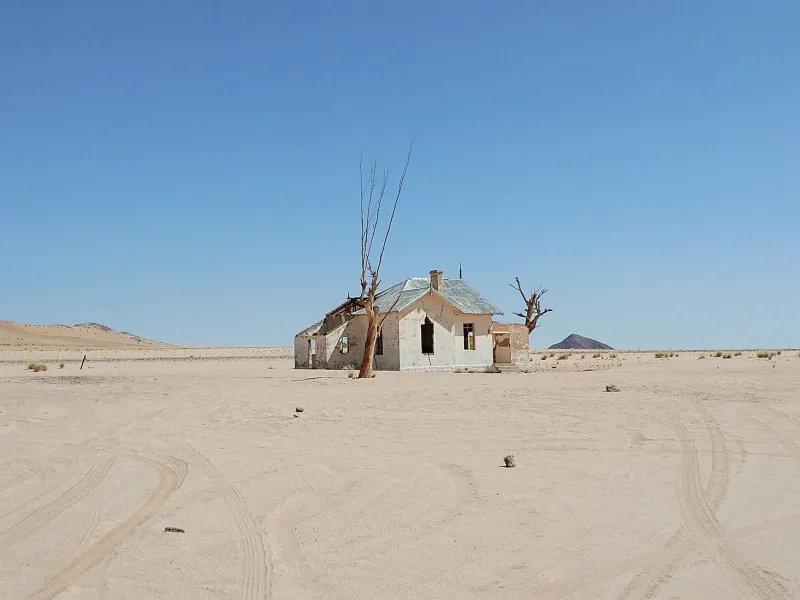
If deserts strip things down, ruined cities layer them up. An abandoned city is a palimpsest — every crumbling wall, every overgrown street, every collapsed roof tells you something about who built it, why they left, and what they valued enough to construct in stone.
The genius of the ruined city as a worldbuilding element is that it communicates civilization and its absence simultaneously. You get the architecture of ambition alongside the evidence of collapse. And in that gap — between what was built and what remains — a world reveals its deepest anxieties.
What did this civilization prioritize? What did it get catastrophically wrong? The ruins answer both questions at once. Grand temples beside collapsed housing. Elaborate military fortifications that clearly failed. Infrastructure that suggests a population far larger than whatever's left. Every detail is a clue, and readers become archaeologists whether they mean to or not.
This is also where genre fiction does something that pure historical fiction can't: it gets to invent the collapse. The worldbuilder decides what brought this city low — and that choice is never neutral. It's always a comment on something. The civilization that fell because it overextended. The city that emptied because the resource it was built around disappeared. The settlement that was simply abandoned when something better came along, leaving everything exactly as it was. Each version tells a different story about what civilizations are actually for.
The Void and What It Does to the Mind
Sci-fi has its own version of the empty space problem, and it operates on a scale that fantasy rarely attempts: the void of space itself. Not the romanticized, star-filled backdrop of a thousand posters, but the actual, crushing nothing between systems — the distances so vast that human brains genuinely cannot process them without flinching.
When science fiction engages seriously with interstellar emptiness, it does something fascinating: it makes the universe itself feel hostile. Not because anything is attacking. But because the absence of anything — of light, of warmth, of other minds — is its own kind of threat. Isolation at that scale isn't just lonely. It's existentially destabilizing.
Worldbuilders who build this seriously into their universes use the void to explore what consciousness does under extreme isolation. What stories do people tell themselves? What do they start to believe? What do they hold onto and what do they let go? The empty space becomes a laboratory for the most fundamental questions about identity and meaning — and it doesn't need a single plot event to do it.
Freedom in the Wasteland
Not every empty space in genre fiction is ominous. Some of the most interesting worldbuilding uses desolation as a site of freedom rather than threat. The wasteland beyond the empire's reach. The unmapped territory where the old rules don't apply. The dead zone that becomes, paradoxically, the only place where certain characters can finally breathe.
This is emptiness as liberation — the flip side of its more foreboding uses. And it's just as revealing about a world's power structures. If civilization is where the rules are enforced and the empty spaces are where the rules break down, then who chooses to live in those empty spaces tells you everything about who the rules were designed to exclude.
The outcasts in the wasteland. The rebels in the dead zone. The survivors in the ruined city who've built something new in the shell of something old. These communities — living in the spaces that power forgot or couldn't be bothered to control — are often where genre fiction locates its most radical imagination.
Because emptiness, it turns out, is never really empty. It's just waiting for someone to look at it properly.