Which Way Is Home: What Fictional Navigation Systems Tell Us About the Worlds That Built Them
Every culture in human history has had to answer the same basic question: where are we, and how do we get somewhere else? The answers have been wildly different. Stars. Magnetic fields. Landmarks. Ocean swells. The position of the sun. And embedded in each answer is an entire worldview — what the culture trusts, what it fears, what it considers fixed and what it considers fluid.
Fiction inherits this completely. When a worldbuilder decides how their civilization navigates — whether literally across space or metaphorically through life — they're making an argument about that civilization's soul. The best writers know this. The rest stumble into it accidentally and still manage to say something true.
The Compass That Lies, Beautifully
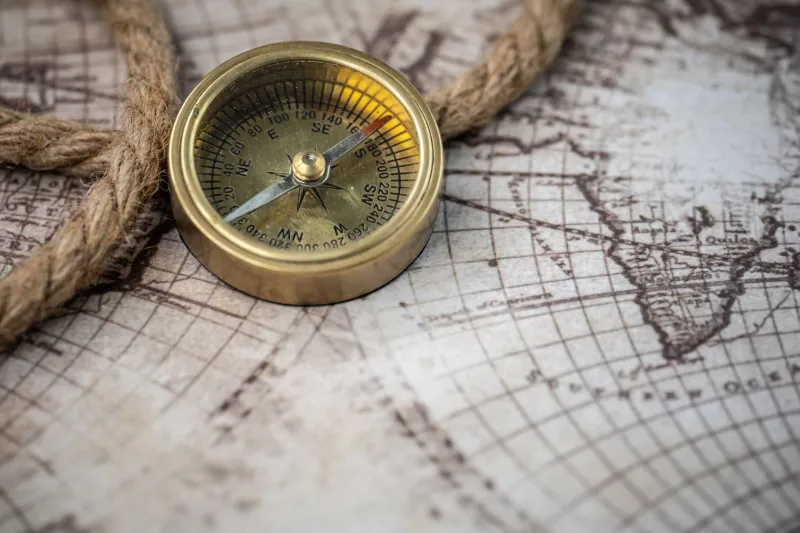
One of the most memorable navigation tools in recent fantasy is the alethiometer from Philip Pullman's His Dark Materials — a device that doesn't point toward magnetic north but toward truth. It's a compass for meaning, not direction. And that distinction is everything.
Pullman's world is preoccupied with knowledge, institutional deception, and the violence done to children in the name of doctrine. Of course its most important navigational instrument is one that cuts through lies. The alethiometer isn't just a plot device — it's a thesis statement. In a world where the Church controls information and suppresses inconvenient truths, the ability to find true north in a metaphysical sense is the most radical act imaginable.
This is the navigation-as-values principle in its purest form. What a fictional world uses to orient itself reveals what that world believes can be trusted.
Stars That Mean Something Different Here
In most real-world navigation traditions, stars are fixed reference points — reliable, distant, indifferent. But fictional worlds can reassign that meaning entirely.
In some fantasy settings, stars are the souls of the dead. In others, they're divine eyes watching mortal affairs. In others still, they're navigation beacons left by a predecessor civilization that has since vanished. Each of these framings changes everything about how characters relate to the night sky — and, by extension, to death, to the divine, to history.
The Wheel of Time's cosmology uses the stars and the turning of ages as a structural metaphor for the entire series. Time isn't linear; it cycles. Navigation in that world — physical and spiritual — is always about understanding where you are in the pattern, not just where you are on a map. Characters who try to navigate purely by geography miss the point. The real orientation is temporal and mythic.
Disorientation as a Weapon
Some fictional worlds weaponize the absence of stable navigation. Space stations and generation ships in hard sci-fi often deliberately disorient their inhabitants — no sunrise, no magnetic pole, no consistent gravity to tell your body which way is down. This isn't just a technical detail. It's a psychological and political condition.
Ursula K. Le Guin's The Dispossessed opens on Anarres, a world with a thin atmosphere and a harsh, nearly featureless landscape. Navigation there is intimate and local — you know your immediate territory or you die. The political philosophy of Anarres, an anarchist society built on mutual obligation and small community, maps directly onto this navigational reality. You can't rely on distant institutions or centralized authority when your survival depends on knowing the ten kilometers around you.
Contrast that with Urras, Anarres's lush sister planet, where navigation is easy, roads are well-marked, and the state infrastructure extends everywhere. And, not coincidentally, so does state control. Le Guin isn't being subtle, but she doesn't need to be. The geography and the politics rhyme perfectly.
The GPS Problem in Worldbuilding
Here's where this gets interesting for contemporary worldbuilding: we live in a GPS era. Most Americans have never needed to navigate by stars, landmarks, or dead reckoning. We've outsourced orientation entirely to a satellite network, which means we've also outsourced the anxiety of being lost.
Fictional worlds that want to generate genuine disorientation have to work harder now than they did fifty years ago. Readers who grew up with smartphones have a different relationship to lostness than readers who grew up with paper maps. The best current worldbuilders account for this by making their navigation systems do more than locate characters in space — they locate characters in meaning.
N.K. Jemisin does this brilliantly in The Broken Earth trilogy. The Stillness — the name itself is a savage irony — is a world of constant geological upheaval where the ground literally cannot be trusted. Navigation becomes an act of radical uncertainty. You plan routes knowing they may not exist when you arrive. The orogenes who can sense and manipulate geological forces have a navigational sense that ordinary people lack, which immediately codes them as other, as threatening, as something to be controlled. The ability to find your way in that world is political. It always is.
Orientation and Identity
At the deepest level, navigation systems in fiction are about identity. To know where you are is to know who you are relative to everything else. Civilizations that navigate by the stars are telling you they look up. Civilizations that navigate by underground rivers or root systems are telling you they look down. Civilizations that navigate by the position of other people — social mapping, relationship networks, community knowledge — are telling you that their world is fundamentally human-shaped.
The next time you pick up a fantasy novel or fire up a sci-fi series, pay attention to how the characters find their way. Not just across continents or through hyperspace, but through uncertainty, through crisis, through the moments when the familiar markers have all gone dark.
Because the question every navigational system is really answering isn't where are we?
It's what do we trust when we don't know?
And that question, in fiction as in life, tells you everything worth knowing about a world.